When I was first diagnosed with RA thirty years ago I met an OT at the hospital and learned the Principles of Joint Protection. One of the most important 'rules' is that you always use a larger stronger joint to perform an activity when possible. So it is better to push yourself up from chair using your forearms rather than your hands or fingers. You need to preserve the small easily damaged joints.

Often the first thing people think of with OT and inflammatory arthritis are the items that can be used to help with daily activities. There are household items like key turners and kitchen items. My favourite of all time is the right angled knife.

It makes cutting so much easier on my hand and wrists. I also preserve my finger joints when I write by using pens with a large barrel or made larger as you see in this picture:

There are so many ways that an occupational therapist can help you to carry on with doing the things that are important to your life and your job. They usually start with an assessment and make a treatment plan for you - perhaps including special exercises, or modifications of the ways you do things.
Here's an example of a life-changing OT experience from my friend Julia who was suffering every time she had to use her washroom. Her knees were causing so much pain that it would sometimes take her 30 minutes to get off of the toilet and carry on with her activities. One visit from an OT and a raised toilet seat solved her biggest problem. She actually says "Now I love my toilet!" How many people have you ever heard say that?

So my advice would be that if certain activities are becoming difficult or if you are having a lot of pain in a specific area you should get a referral to consult an occupational therapist. They can help with any joints but especially if your hands or wrists are affected by Rheumatoid or Osteoarthritis.
Below are two signs that there may be an OT in the vicinity.


There are many types of splints and supports that an OT can make, or help you to find for your hands and fingers. Here are pictures of two types that have helped me.

Resting splints can help with wrist pain and maintain good hand and finger positioning.
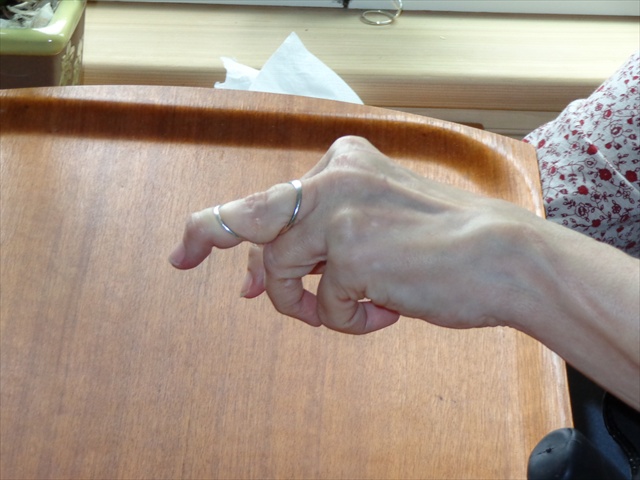
You can also have your work area assessed to see if you are working ergonomically.
I am concentrating here on only one area where OTs can specialize. They also play a large role in helping anyone learn better ways to live and deal with a large range of problems from autism to stroke to mental health.
There is more information about splints in this post. from the past. I'd like to take this chance to thank the OTs who have helped me through the years.
More Reading
From the American College of Rheumatology about OTs


Fantastic blog article Annette. I would like to add in that I would personally seek out an OT before the deformities start. It was only after I had hyperextention that I was referred, whereas maybe if I'd had my silver ring type splints earlier, maybe the damage would have been less. I also have an angled stool for helping me in the kitchen and sofa risers have also been useful to me in the past.
ReplyDeleteThanks for the feedback Gilly. OTs are such a great help in coping with so many types of problems. I think that y hands would be worse without the resting and silver ring splints
ReplyDeleteThis comment has been removed by a blog administrator.
ReplyDelete